

When I started thinking about creating a consulting company, it seemed like there were a million things to consider – legal paperwork, how to accurately and honestly describe my work and experience, decisions about hosting, and, of course, building a website that clearly communicates what I actually do. In consulting, people need to understand your expertise, or they simply won’t know why they should trust you with their data or decisions.
That brought me back to something I’ve always taken seriously: the ethics of representing one’s capabilities honestly. As a long-time member of both the American Statistical Association (ASA) and the American Society for Quality (ASQ), I’ve always been aware of the professional guidelines we commit to. In fact, the ASA’s first principle—Professional Integrity and Accountability—begins with a simple directive: “Represent your capabilities and activities honestly.”
That sentence made me pause and ask a bigger question:
What does it really mean to be an expert?
If you ask people casually, you’ll often hear the famous “10,000 hours” rule—put in 10,000 hours of practice, and you become an expert. As a statistician who has spent 25+ years in statistics, data science, and analytics leadership, I can’t help but raise an eyebrow when numbers like that get tossed around. What’s the margin of error? What was the sampling method? Was the estimate representative of all fields or based on a very specific type of work?
So I went back to the original source.
Malcolm Gladwell popularized the idea in his book, Outliers, pointing to people like Bill Joy, the Beatles, and Bill Gates—all of whom had extraordinary access to opportunities that allowed them to practice intensely for years. But Gladwell didn’t invent the rule. He was drawing on research by K. Anders Ericsson, especially the 1993 paper The Role of Deliberate Practice in the Acquisition of Expert Performance.
Ericsson and his colleagues studied elite violinists and pianists, documenting their practice habits in detail. The best musicians practiced multiple hours per day in highly structured, mentally demanding ways—often in the morning when they had the most focus, followed by rest to recover. This wasn’t casual playing. It was focused, intentional work that pushed the edge of their ability.
After about ten years of sustained, deliberate practice, many of these musicians reached a level that made world-class orchestras a realistic next step. If you do the math—three hours per day for ten years—you end up in the neighborhood of the now-famous 10,000 hours.
But here’s the part that often gets lost:
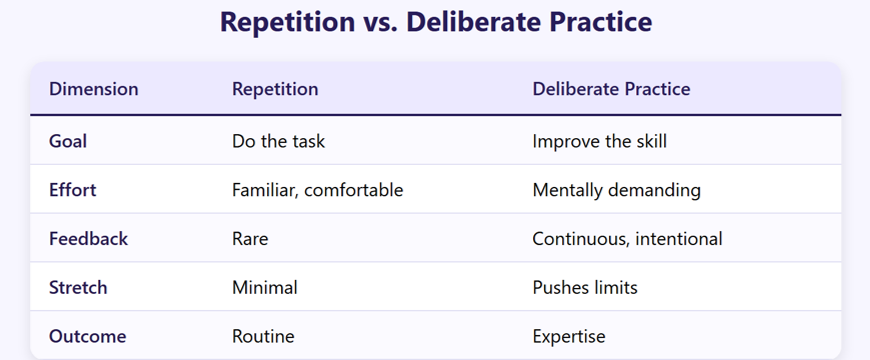
It’s not just the hours. It’s the deliberate hours.
Just doing something repeatedly doesn’t make you an expert. Millions of people drive a car every day, but that doesn’t qualify them to race at Le Mans. Commuting isn’t deliberate practice. It doesn’t stretch ability, push limits, or require deep reflection.
So how does this apply to analytics?
In statistics and data science, expertise isn’t measured by how long you’ve coded in Python or how many regression lines you’ve fit. True expertise comes from years of solving ambiguous problems, making decisions under uncertainty, validating assumptions, catching flawed logic, and learning from real-world outcomes. It comes from mentoring others, presenting your work, building systems, designing experiments, and understanding how analytics integrates with business value—not just algorithms.
In other words:
Expertise in analytics isn’t just repetition; it’s the combination of disciplined practice and informed judgment.
Expertise isn’t something you suddenly “hit” at 10,000 hours. It’s built through deliberate, thoughtful practice over time—asking hard questions, learning from mistakes, challenging assumptions, and continually stretching yourself to get better.
As I continue writing, I’ll use this space to share the ideas, tools, and experiences that have influenced my approach to analytics—whether technical insights, leadership lessons, or reflections drawn from years of working with complex and evolving data. My hope is that these posts offer something useful, practical, and thought-provoking for anyone navigating today’s data-driven landscape.
Thank you for reading my first post. I look forward to what comes next and to helping organizations and individuals use analytics more effectively and with greater confidence. I’ll leave you with a question:
What is one skill or habit you’re willing to practice more deliberately as you grow your own expertise?
References
American Statistical Association. (2022). American Statistical Association Ethical Guidelines for Statistical Practice. Zenodo. https://doi.org/10.5281/zenodo.7092386
Gladwell, Malcolm. Outliers: The Story of Success. New York: Little, Brown and Company, 2008.
Ericsson, K. Anders, Ralf Th. Krampe, and Clemens Tesch-Römer.
“The Role of Deliberate Practice in the Acquisition of Expert Performance.” Psychological Review 100, no. 3 (1993): 363–406.
Thanks for sharing your insight on expertise! I appreciate that you highlight deliberate, intentional practice focused on growth as part of the path to expertise. One skill I am working to grow is using statistical guidelines to make better informed decisions and recommendations in my engineering role.